

Origins & Foundations (2011–2013)
The 2011 Transit Crisis
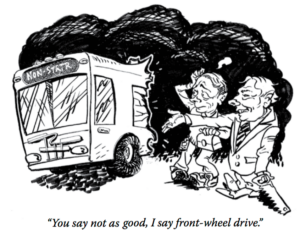
The origin of TRU dates back to the summer of 2011. Three years into the Great Recession, King County Metro faced a massive budget crisis due to declining sales tax revenue. Fares had already been raised four times since 2008 (an 80% increase) and politicians proposed deep cuts to vital bus service.
A small, dedicated group of transit riders refused to accept the ultimatum that working and poor people should bear the brunt of economic stabilization through slashed services or higher regressive hits to their income. Activating a grassroots public outcry, this group pressured the King County Council into staving off the immediate cuts with a temporary car tab fee.
Why We Formed a Union

We knew a temporary car tab fee wasn’t a permanent solution, nor were we satisfied with further taxing working people. Looking back at history, we saw undeniable parallels between our era and the Great Depression of the 1930s, when inequality was rampant and working conditions were intolerable. How did everyday people win living wages and structural protections like the New Deal back then? They organized and formed unions.
To counterbalance the pressure that governments constantly receive from corporate elites, we recognized the need for a permanent organization to apply pressure from below. In the fall of 2011, we drew up our core Mission and Principles and founded the Transit Riders Union, establishing a 21st-century model for organizing poor and working people.
First Mobilizations: Saving the Ride Free Area
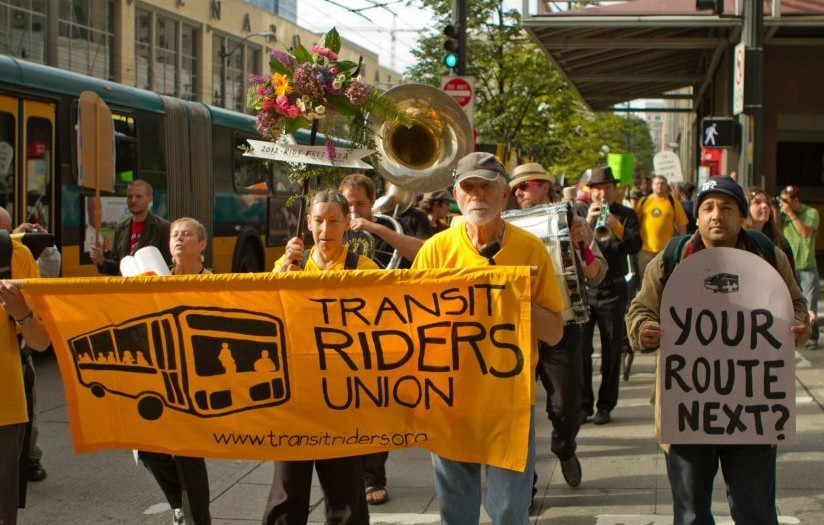
In 2012, as a young and growing organization running entirely on volunteer labor, TRU launched a high-visibility campaign to protest the closure of Downtown Seattle’s Ride Free Area, gathering thousands of signatures and staging the dramatic “Ride Free Area Funeral March”. While the city ultimately closed the zone, the sheer momentum of our campaign forced a massive regional shift, laying the direct groundwork for our next major escalation: a permanent, systemic low-income fare.
Escalation & Early Wins (2014–2016)
Winning ORCA LIFT & Transit Equity
After three long years of unrelenting petitioning, coalition-building, and direct testimony before elected officials, TRU secured a historic breakthrough in March 2015: the launch of King County’s ORCA LIFT program. As one of the first and largest low-income fare programs in the United States, ORCA LIFT set a powerful national precedent for transit equity. We immediately expanded this win in 2016 by pressuring Sound Transit to accept ORCA LIFT on regional Express Buses and Sounder Commuter Rail.
Connecting Transit to Economic Justice
True to our commitment to intersectionality, TRU recognized that transit justice cannot exist in isolation from economic survival. In 2014, we threw our full organizational weight behind the historic fight for Seattle’s $15 minimum wage floor. Simultaneously, we organized alongside Rainier Beach High School students to secure $1 million per year in dedicated city funding for low-income student transit passes, a program implemented in 2016.
Building Political Accountability
As our campaigns expanded, we recognized that winning required directly challenging the political landscape. To give us the total freedom to endorse progressive candidates and aggressively lobby for legislation, TRU officially structured itself as a 501(c)(4) democratic organization. Backed primarily by our own members’ sliding-scale dues rather than corporate foundations, we preserved our absolute independence from the corporate class and government agencies.
Early TRU Wins
| Fall 2014 | Secured a 33% funding increase for the Human Services Reduced Fare Bus Ticket program for unhoused neighbors. |
| March 2015 | ORCA LIFT goes live, revolutionizing regional access. |
| Fall 2015 | Campaigned for a progressive “Dream Team,” electing 3 of 5 endorsed candidates to Seattle City Council. |
| March 2016 | Coordinated and launched the first comprehensive, SDOT-supported Seattle Transit Map. |
Regional Expansion & Economic Justice (2017–2024)
Over the past decade, the Transit Riders Union recognized a fundamental truth: public transit does not exist in a vacuum. A reliable bus line does a rider no good if they are priced out of their neighborhood or paid starvation wages that don’t cover rent. TRU expanded its mission, proving that when working and poor people organize, we can win structural change across the entire Puget Sound region.
Taxing Big Business to Fund Our Communities
For years, TRU fought against regressive sales taxes and car tab fees that forced working families to pay for basic public infrastructure while multinational corporations paid virtually nothing. Starting in 2017, TRU co-led the fight to tax big business. Despite fierce pushback from corporate lobbyists, our unrelenting grassroots pressure culminated in the passage of JumpStart Seattle in 2020, a progressive payroll tax raising over $200 million annually for social housing, climate resilience, and community services.
Organizing for Housing as a Human Right
As displacement accelerated, TRU stepped up to organize tenants. We spearheaded campaigns to pass landmark eviction protections, cap predatory landlord fees, and secure legal defense for tenants in Seattle. Recognizing that the housing crisis spans city borders, we took the fight south, winning historic tenant protection ordinances in Burien and unincorporated King County.
Transit Equity & Living Wages for All
Our commitment to transit and economic justice never wavered. Building on our earlier student-led campaigns, TRU helped win Free Transit Passes for All Youth across the state in 2022. Simultaneously, we organized low-wage workers in South King County to pass ballot measures and ordinances in Tukwila and Burien, raising the local minimum wage floor to over $21 an hour and proving that grassroots union power can reshape the regional economy.
The Wilson Campaign & The New Era (2025–present)
By 2025, over a decade of unrelenting organizing by Transit Riders Union members had permanently altered the regional policy landscape. From winning reduced fares and expanding tenant protections to establishing historic municipal wage floors, TRU proved that working-class people could organize, build coalitions, and take on corporate interests.
From the Streets to the Mayor’s Office
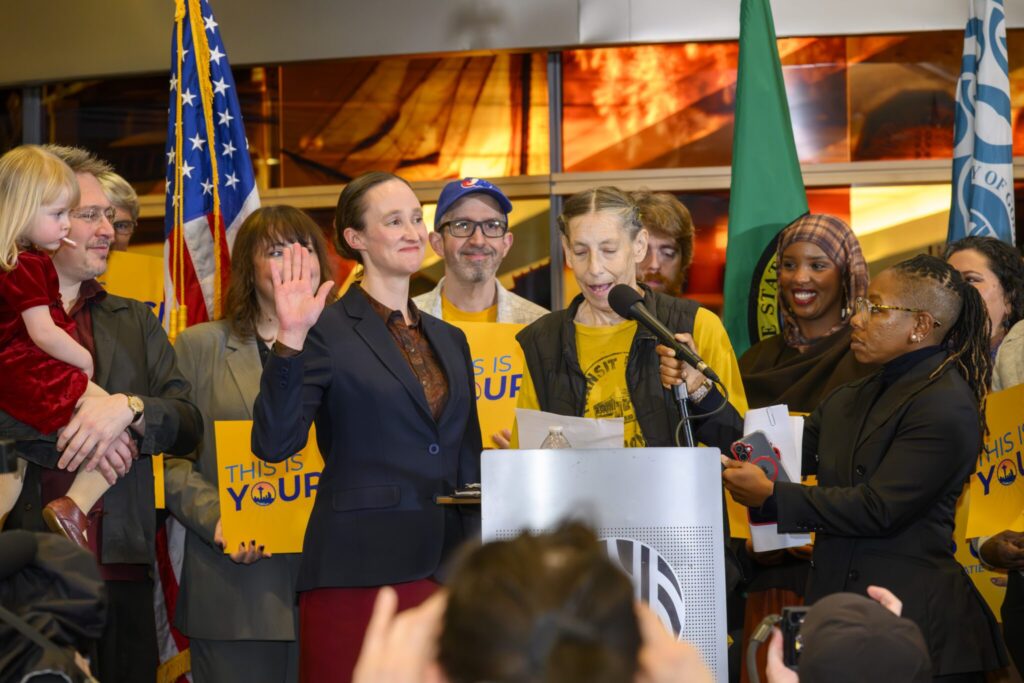
That collective power reached a major turning point in 2025 when TRU cofounder and longtime Executive Director Katie Wilson launched a campaign for Mayor of Seattle. Grounded in TRU’s core values of transit equity, social housing, progressive revenue, and worker power, her campaign brought together thousands of volunteers, labor unions, and neighborhood organizers across every corner of the city. In November 2025, Seattle voters elected Wilson as Mayor, defeating the incumbent and proving that the working people of this region were ready to take control of their own future.
Holding Power Accountable from Below
As we step into 2026, TRU enters a transformative new chapter. While having a dedicated grassroots organizer at the helm of municipal government opens unprecedented opportunities for working-class policy wins, TRU’s mission remains unchanged.
We are (and will always remain) an independent, democratic membership organization run by and for working and poor people. Governments and politicians change, but the need for organized people power never stops. TRU continues to organize riders on bus lines, build tenant unions in apartment complexes, mobilize for regional economic justice, and ensure that every elected official in City Hall and beyond is held directly accountable to the communities who put them there.
The fight for a just, affordable, and sustainable Puget Sound region is far from over. We are ready for the work ahead.
Join us to take the next step! Become a member of the Transit Riders Union. Let’s get organized and build a movement that can change the world!